
Recommendations for using VMP vacuum Metallized pigments - Mirror Chrome aluminum pigments:
First say, the more flatter, darker, and shinier the base, the more mirror-like of VMP used in printing inks and coatings .
The thinner the vmp layer, the more mirror-like it will be.
Establishing the layers neatly will prevent fogging and a grayish appearance.
Finally, apply a clear coat for protection to prevent the silver from showing through.
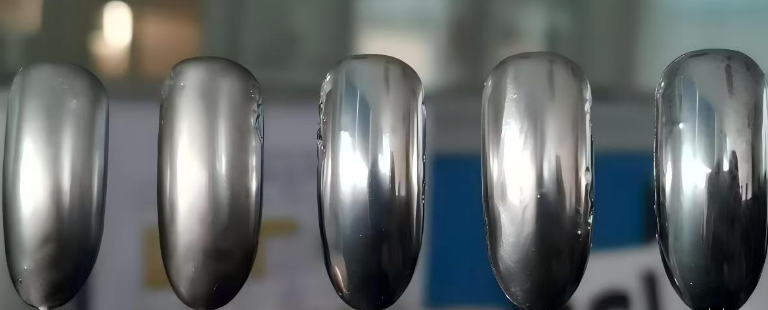
The VMP layer is extremely thin; it will faithfully reflect all the sandpaper marks, orange peel texture, pinholes, and wavy lines underneath. Therefore, the base is the foundation.
Shan Dong Jie Han Metal material co.,ltd is a professional VMP Aluminum pigment manufacture .
First, remove oil, dust, and rust from the substrate: Adhesion treatment can be applied to plastic parts; remove oil and rust from metal parts; glass/PET/PC must be clean and oil-free. The substrate must be clean, smooth, and have low roughness; otherwise, brightness and clarity will be reduced.
High-gloss UV primers are commonly used in industrial/plastic shells: The UV primer must have good leveling, hard curing, and an extremely smooth surface. In plastic shell processes, the UV primer is approximately 15–20μm thick, followed by IR leveling and UV curing. High-end processes may involve polishing to give the aluminum paste a "glass-like" surface.
For handmade/model/auto repair projects, start with a high-gloss black base: For a truly deep and glossy mirror silver finish, a high-gloss black/dark gray base is essential. If the black base is dull or has sanding marks, the VMP layer will appear dark, mottled, and unclear.
How to spray the black base? Shan Dong Jie Han suggest you apply multiple thin coats of black base, allow it to dry completely, then lightly sand it to ensure a dust-free finish. The goal is a "mirror-like black gloss," not just any black paint. The final finish should resemble black piano lacquer before applying the VMP.
Spraying mirror ink: Shan Dong Jie Han recommended volume/weight ratio is approximately main agent: additive: thinner 10: 0.1-0.2: 20-40 . Use a 0.5-1 mm nozzle spray gun, applying multiple thin coats; avoid applying thick layer.
VMP addition: The amount of VMP added to the spraying system is approximately 2.5–10%, and the resin/pigment ratio is crucial—too much resin will bury the aluminum flakes and darken them; the aluminum flakes should be arranged parallel to each other on the surface.
Aluminum paste/VMP is susceptible to high shear: Low speed dispersion is recommended, with a rotor linear velocity of approximately 1.5–2 m/s.
Solvents affect hue/clarity; alcohol ethers/esters/ketones/aromatics are recommended, while alcohol-based hydroxyl/amino solvents should be avoided. Water-based/mirror inks are also susceptible to moisture; high humidity results in poor mirror finish because the aluminum flake/solvent system is sensitive to moisture, causing slow drying and white fogging.
A test spray on a scrap part is essential before spraying: check atomization, flow rate, fan width, distance, and wet/dry conditions.
Remember this: Shan Dong Jie Han VMP is not about covering it completely; it's about stopping when it's just thin enough for reflection. Distance/Technique: For hand spraying/models, maintain a distance of approximately 20–25 cm or use a test spray. Maintain a steady speed and overlap the powder by 1/2–1/3, avoiding stopping in one spot. For automotive silver powder, also emphasize a steady speed, constant distance, slightly diluted powder, and multiple thin coats; too close will disrupt the powder's arrangement, too far will cause it to scatter.
Coat Order: First, apply a light, misty first coat for positioning. Allow it to flash-dry for 5–10 minutes before applying the second coat. Stop when the black base is evenly covered and metallic reflection appears. Some Engineer suggest a very thin, mirror-finish silver of approximately 5–8 μm; repeated spraying is strictly prohibited. Finally, use a smaller paint outlet, slightly higher atomization, and an extremely thin, clear sweep spray to enhance the silver flake arrangement, but avoid a thick, wet coat.
Air pressure is a balancing act: atomization should be fine, but avoid strong, direct airflow—too low pressure results in coarse atomization, while too high pressure will disrupt the wet film, scatter the silver flakes, and cause localized unevenness. Industrial techniques often involve low pressure, high paint volume, and a fan-shaped spray pattern to achieve a thick film in one pass. Hand spraying, on the other hand, emphasizes increased atomization but with a small, fast, and even application. The essence is to allow the silver flakes to lie flat on the wet film surface, not to be churned up by airflow.
Many people overlook this step. After spraying, do not immediately apply strong airflow, high temperatures, or a clear coat. Allow 5-10 minutes at room temperature to allow for leveling, controlled solvent evaporation, and for the aluminum flakes to lie flat and parallel. It is recommended to air dry for at least 5 minutes before placing it in a drying machine; slow drying with too much solvent or prolonged exposure to heat will cause the aluminum flakes to scatter and result in a white haze.
Drying should be "gentle": For plastic casings with a mirror silver finish, bake at a low temperature of 60-70℃ until fully dry; for PC/acrylic, which is not heat-resistant, bake at a low temperature for a longer time; for water-based al powder, don't bake it too intensely at once, allow each layer to dry completely before moving on to the next, otherwise it will turn white/bubble/glossy.
This is easy to remember,Shan Dong Jie Han suggest:
White fog = aluminum flakes not properly arranged/too much slow drying/rough base/high humidity;
Blackening = too thick/resin burying the silver flakes/acidic system/aluminum powder oxidation;
Granules = agglomeration/contamination/oil and water/poor filtration;
lifting = clear coat solvent too strong or incompatible layers.
Bare VMP is delicate: fingerprints, alcohol, and scratches can all ruin it. After it is completely dry, apply a high-transparency, high-gloss clear coat; a UV top coat provides both shine and scratch and chemical resistance;
Clear coats can cause "silver burning/lifting /fogging," so start with a small sample! VMP and clear varnish Maybe not have a good match: the strong solvent in clear varnish can cause the underlying layer to swell, the silver flakes to flake off, and the shine to fade instantly. The solution from Shan Dong Jie Han is: ensure the VMP is completely dry, apply a transition layer/thin spray of transition clear varnish, use a dedicated compatible topcoat, add adhesion/anti-silver-flaking additives, and avoid using strong solvents for heavy spraying.
For the brightest finish, use this combination: high-gloss black base → ultra-thin, uniform mirror silver aluminium pigment VMP → completely dry → ultra-thin compatible clear varnish matte layer → then normal 2K/UV high-gloss clear varnish → clear varnish completely dry and polish. Nano-plating/industrial applications also emphasize a final transparent coating for protection; however, polishing should only be done after the clear varnish is completely dry, otherwise, sandpaper marks/loss of shine will appear later.
This is all contents today sharing about VMP formula and use guidance for your reference. For more Technical details, pls find us SHAN DONG JIE HAN METAL MATERIAL CO.,LTD.